After World War 1 War Might Be But It Would Never Again Be
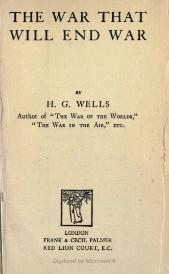
"The war to end war" (also "The war to end all wars";[1] originally from the 1914 volume The War That Will End War by H. Chiliad. Wells) is a term for the First World War of 1914–1918. Originally an idealistic slogan, information technology is at present mainly used sardonically,[ii] since not only was the First Globe War not history'southward final war, merely its backwash likewise ironically directly contributed to the outbreak of the even more than devastating Second World State of war.
Origin [edit]
During August 1914, immediately later on the outbreak of the war, English language author and social commentator H. Thou. Wells published a number of articles in London newspapers that subsequently appeared as a book entitled The War That Volition End War.[iii] He blamed the Central Powers for starting the war and argued that but the defeat of German language militarism could bring well-nigh an end.[4] He used the shorter form, "the state of war to stop war", for In the Fourth Year (1918), in which he noted that the phrase "got into circulation" in the second half of 1914.[5] It became one of the almost mutual catchphrases of the First Earth State of war.[4]
After utilize [edit]
During the First Globe War, the phrase met with some degree of skepticism. As it became apparent that the war had not succeeded in ending state of war, the phrase took on a more than cynical tone. The British staff officer Archibald Wavell, a hereafter field marshal and viceroy of Bharat, said despondently of the Paris Peace Conference, "Afterward the 'war to stop war', they seem to have been pretty successful in Paris at making the 'Peace to terminate Peace'."[half-dozen] Wells himself used the phrase in an ironic way in the novel The Bulpington of Blup (1932).[7] Walter Lippmann 1967, "The delusion is that any war we are fighting is the war to terminate state of war", while U.S. President Richard Nixon, in his "Silent Majority" speech (1969), said, "I do not tell you that the war in Vietnam is the war to cease wars".[2] The 1976 Eric Bogle song "No Man's Land" ("The Light-green Fields of France"), addressed to the grave of a xix-twelvemonth-former soldier in a First World War Cemetery, contains the lyric "Did you actually believe that this state of war would end wars?".[eight]
Since at to the lowest degree the last 3rd of the 20th century, the alternative wording "the war to end all wars" has get more popular. The State of war to Finish State of war was the championship of Laurence Stallings's 1959 book on the war.[9] Information technology was also a championship of a chapter of the American high school history textbook The American Pageant (first published 1956), and remained so up to its 15th edition in 2013.[10] Still, "The State of war to Terminate All Wars" was used by later authors such as Edward 1000. Coffman (1968), Russell Freedman (2010) and Adam Hochschild (2011).[11] [12] [13]
Run across besides [edit]
- Mutual assured destruction
- Peace for our time
- Never once more
- Mission Accomplished voice communication
References [edit]
- ^ The state of war to end all wars BBC News 10 November 1998
- ^ a b Safire, William (2008). Safire'due south Political Lexicon. Oxford University Printing The states. pp. 792–3. ISBN978-0-xix-534334-2 . Retrieved 2010-08-24 .
- ^ Wagar, Westward. Warren (2004). H.G. Wells: Traversing Fourth dimension. Wesleyan University Press. p. 147. ISBN978-0-8195-6725-3 . Retrieved 2010-08-24 .
- ^ a b Rempel, Richard A., ed. (2003). The Collected Papers of Bertrand Russell. Routledge. p. 10. ISBN978-0-415-10463-0 . Retrieved 2010-08-24 .
- ^ Wells, H. G. (2008). Short Works of Herbert George Wells. BiblioBazaar, LLC. pp. 13–14. ISBN978-i-4375-2652-3 . Retrieved 2010-08-24 .
- ^ Pagden, Anthony (2008). Worlds at State of war: The two,500-year Struggle between East and Due west. Oxford Academy Printing US. p. 407. ISBN978-0-nineteen-923743-2 . Retrieved 2010-08-24 .
- ^ Wells, H. G. (1932). The Bulpington of Blup . pp. 161, 163, 173. ISBN9781409725664 . Retrieved 2010-08-24 .
- ^ Walsh, Michael J. K. (2018). Eric Bogle, Music and the Dandy War: 'An Old Man'due south Tears' . Routledge. p. 92. ISBN978-1351764483 . Retrieved nine May 2019.
- ^ Stallings, Laurence (1959). The War to End State of war. American Heritage Publishing Company. Retrieved 8 Dec 2018.
- ^ "The American Pageant - 15th Edition". APNotes.internet . Retrieved 8 December 2018.
- ^ Coffman, Edward Thou. (1968). The War to Cease All Wars: The American Armed forces Feel in World War I . Oxford University Press. Retrieved 8 December 2018.
- ^ Freedman, Russell (2010). The War to End All Wars: Earth War I . Clarion Books. ISBN978-0547026862 . Retrieved 8 December 2018.
- ^ Hochschild, Adam (2011). To End All Wars: A Story of Loyalty and Rebellion, 1914-1918 . Houghton, Mifflin, Harcourt. ISBN978-0547549217 . Retrieved eight Dec 2018.
External links [edit]
- H. G. Wells, The War That Will End State of war on the Internet Archive
Source: https://en.wikipedia.org/wiki/The_war_to_end_war

Post a Comment for "After World War 1 War Might Be But It Would Never Again Be"